Spatial Clinic for the Homeless
▻ Français
The homeless person substitutes for history’s word-by-word his or her dangerous step-by-step at the boundary of space and of an always possible death. Homeless persons are at the forefront of the need for a spatial reading of mental conditions, on a globalised planet whose peril is generating new ways of living and thinking, but also of reacting and suffering. We will first tell the story of a hospitalization which enabled a homeless patient to be rehabilitated and recover her movement. We will then analyse the place and role of the different spatial elements at work in evaluating and treating the homeless.
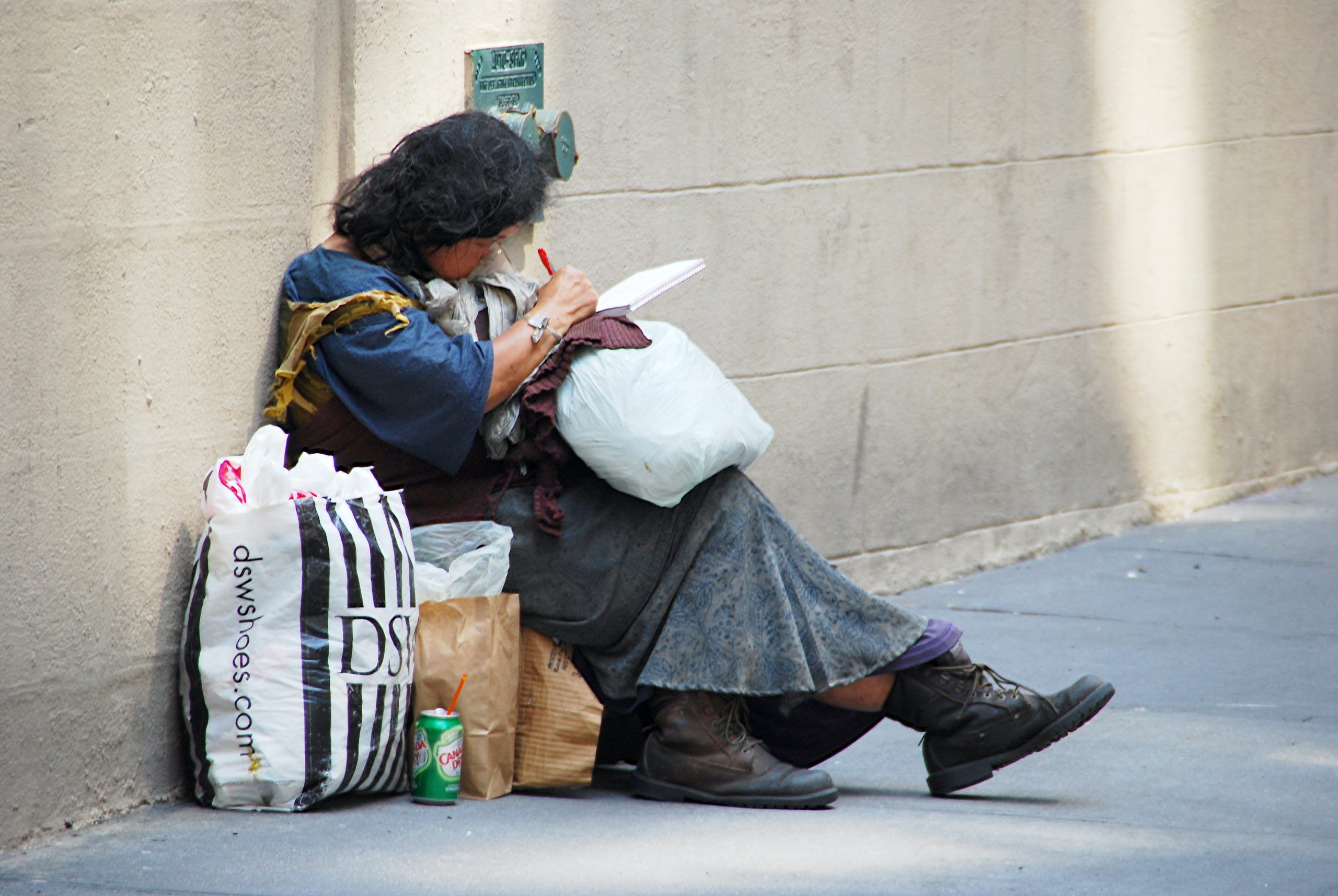
We will call her Suzanne. She came to us strapped to a stretcher in an ambulance escorted by the police. Her file in the emergency department of the Rouyn Noranda hospital, where she had already “stayed” recently, told us that she was originally from the Gaspé region, at the mouth of the St. Lawrence River, and that an agency in Quebec City organizes her work as a touring striptease dancer. When we received her, she was dressed for her work, as she had just been ejected by force from her third-rate club because she was violent and was attacking customers, whom she accused of conspiring against her. In this boreal region through which she was passing, uprooted and caught up in the storm, she had lost her bearings. “Nude” dancer, cocaine addict, dissociative, borderline and homeless: a boreal version of the famous film “Desperately Seeking Susan”! In the corridors of the emergency department, she was agitated, half-naked, ready to take off into the open countryside in the cold night. As in the film, as with Madonna, she was swept up by movement, lost, without a stable and familiar place, apart from her fleeting saloons and seedy motels.
Caught in an environment which changes every two weeks and in a movement which was constantly casting her out, she was trying desperately, like others in similar circumstances, to stay warm and to hang on in the artificial paradise of alcohol and drugs. They precipitated her fall, she became estranged from society, and in the end she took refuge in a delirium in the form of adversity. Her state required a pause, the time needed to re-appropriate the free electron that her body had become. For us to do our work and to put this electron back into orbit she required hospitalization, which she rebelled against at first.
The Halt
In the absence of an available bed in the psychiatric department, she was initially placed in an isolation room in the emergency department. From there, she escaped on several occasions when going outside to smoke, although accompanied. She was brought back, freezing, dishevelled and vociferous. And yet, as with maniacal disoriented patients, the forced staying in place, the enclosed space, was indispensable to establishing a connection. Coming from a region of Quebec 800 kilometres away, as is often the case with the homeless, the first dilemma strangely posed itself: where to hospitalize her?
Rather than sending her back escorted in an ambulance to her regional hospital, in her case we decided to treat her on site, with the idea that she return home herself at the end of her hospital stay. By avoiding classifying her as a borderline, delirious drug abuser too hastily, what we hoped to provide her by offering her a halt was for her to find her way again. Our care facility should enable her, first of all, to recover her spatial harmony. We hoped that she would then recover her mobility and voice.
Movements
Once her agitation and delirium had dissipated, she was transferred from emergency to a recently renovated psychiatric service with the goal of establishing an architectural equilibrium where the movement between rooms and public spaces would be more fluid. She would be able to circulate freely within the boundaries of the department. At the time she was incapable of remaining seated in an office to talk for more than thirty seconds; she jumped back up quickly. Her discussions with care workers were limited, ranging from a few steps taken together in the hallway to an assisted stroll through the hospital. Nevertheless, the area in which she moved would grow larger and more complex each day. We observed, as stages of her evolution, her ability to use the transitional curatorial space we provided her and whose constraints she accepted. Slowly, her displacements became more fluid, the perimeter of her movements broadened. She circulated in a more respectful manner towards others, with whom she engaged in snatches of discussions, the first glimmers of bonds.
Boundaries
In order to protect her from an outside world experienced as chaotic and threatening, we first established for her, unilaterally, a boundary between inside and outside: an enclosed room, then a broader but limited range, a closed department. Inside these spaces she learned to recognise the diversity of boundaries – bedroom, common room and hallways – and to respect the boundaries between public and private. As evidence of her evolution, she began to meet us in an office just to talk. At the same time, she re-interiorized her own boundaries, starting with intimate matters. At first she walked around the department in a half-open hospital gown, careless of her nudity. She moved about as if she were still in her club. It was only slowly that she regained awareness of and confidence in her body, particularly when she could get her clothes back. She began to put on makeup again, to take care of herself, and every evening she washed her clothes so she could wear them again in the morning. She was finding herself again.
Conclusion
Let us sum up the process. Without a home of her own, Suzanne appropriated the Department, making it a site for relearning about space. When her agitation, tied to the feverishness of the outside world, was gradually erased, she accepted her hospitalization as a pause in order to rebuild herself. By stages, she recovered her mobility and her integrity, at first within the closed department itself, and then within the hospital and finally in town before, in the end, setting off to return home all alone by bus. She went back to find her mother, who worked as a cleaning person and who had lived her life in motels. A destiny? What served as a witness for us in this clinical ethnographic summary was the body. A spatial approach to homelessness will have to incorporate a gestural semiology which can go from the agitation associated with the feverishness of the particular world of social vagabondage to the prostration in which the subject’s last private space is the boundaries of her body. Her range of symptoms was broad, from prostration, in which, like melancholy, the silent, suffering body becomes the boundary of identity, to the agitation which brings about a torrent of words in a manic state, by way of a fusion and anxious symbiosis with a threatening world, masterfully depicted in Munch’s “The Cry.” As we saw with Suzanne, by slowly recovering her body, she recoverered her individuality and voice. Mission accomplished, Suzanne is once again back in orbit. We used the space not to force her to be sedentary, but rather to give her back balanced movement while respecting her trajectory which since childhood have organized her history. To stimulate reflection, by way of conclusion, we will note that her nomadic spatial orientation, the capacity to organize her space around movement, is widespread in North America. A continental spatial idea which took root in the discovery of the New World with the mythical conquest of the Far West and, more recently, of the boreal region of Abitibi. A continent where psychiatry seeks not so much the truth of the individual as the return of his or her mobility.
Geomental Thoughts
I chose to describe Suzanne’s story over so many others because, of the diverse forms and modes of homelessness this kind is very frequent in young people living on the street in large cities. In Montreal, this vulnerable population has a suicide rate seven times higher than the already-high average for this age group, 40% of which suffer from mental illnesses and have already attempted suicide. For these homeless, what we are most commonly asked when we meet them is to find them a place to stay, or at least confine them. Naturally, other kinds and degrees of homelessness exist, such as a simple passing dropping out because of an emotional or social break-up, by people who, having exhausted the support of family and friends, can find themselves in the street; or a homelessness caused by circumstances, to the point of complete vagabondage, without voice or bearings, a veritable spatial psychosis. Naturally, I also chose to present Suzanne’s wild escapade because of its happy end; to show, precisely, that homelessness is not without hope and that it can end differently. My thoughts here will naturally be based on Suzanne’s story, but also on the hundreds of homeless people I have treated in psychiatric emergency departments over the past thirty years. Whatever the milieu in which I was practising – major city, remote region or native reserve – and whatever the population involved (ethnic or sexual immigrant minorities, more well-rooted citizens) each homeless person signals, first of all, a grave environmental disturbance which often places the weakened subject in a situation of survival. This is when a treatment plan must be decided, to enable the subject to reintegrate his or her milieu harmoniously. Giving voice back to the subject makes it possible to gauge the nature of their problems and their needs with respect to their mental state. Every patient initially requires spatial therapy, whose form, a simple prosthetic or reconstruction, is determined after evaluating the state of the parameters at the base of their geomental equilibrium, whether this consists in stable places, secure movements or permanent boundaries.
The Site as Bond
The inventory of a homeless person’s places often describes their affective history. The floor chosen to sleep on will be that of a former love interest. The public bench will be that of the park in the centre of the neighbourhood where they resided or where they are known. A final existential resistance before sinking, like a dramatic SOS. The familiarity of the environment and its subjectivity are like a last rampart against the risk of being completely disoriented. Before losing their life story, homeless people usually return to the places of that story. The subject then takes refuge in those social sites of homelessness, the mirage of large cities, with their train stations, parks and metros – repurposed public places which they often take over in a minimal fashion. It is not a surprise to find numbers of them in prisons, where they are taken in charge and discharged from the constraints of the street. When a patient says that she is “scattered across several places,” this must also be understood as several bonds which are falling apart, bringing about the de-occupation of a place. The homeless subject will oblige us to be both the place and the bond. Our mission is, first of all, to provide them with security of place in order to re-establish the bond. Shelters appearing first in Montreal and with House First in New York seek to provide, without demanding abstinence or fidelity to medication, a residence to every homeless person suffering from mental illness. Today this movement is extending, in the tradition of shelters around the world offering a roof to the homeless. Their therapy must observe the wordless logic of a bond which arises from a place. Our immediate response is to offer a transitional place in which the subject can halt before finding herself by re-establishing her mobility and itineraries.
Recovered Itineraries
For the homeless person, their itinerary merges with their reality. It is this itinerary as a whole which they cannot shake and which becomes a part of their individuality. The varying degrees of disorganization in the person’s movements and boundaries are an indicator of a degree of their distress. With the homeless, words become gestures, their discourse is choreographed. What they show us and make us understand is movement. Clinical listening will be attentive to the extent and rhythm of the itinerary, to its slow, repetitive circularity or its hyperactivity. By virtue of being travelled and repeated, the itinerary can exhaust itself, generating depressive spatial states. Movement can also be lost in dispersion, sending the homeless person off on boundless vagabondage, resulting in true spatial psychoses. The homeless person’s request for assistance often signals a desire to take a break from her precarious and sometimes dangerous movements. The therapist must agree, first of all, to momentarily take in hand the subject’s itinerary. The area for bodily rest which we provide must also be seen as a stage in the reorganization of the subject’s itinerary. Sometimes, is a simple symbolic marker, a final bond space, for the homeless person who regularly seeks help from an emergency department; “Yes, I have my emergency side. It is always there. You speak about something else, you speak of yourself, of your life.” Most often this is a true provisional mooring point for those who have lost the regular use of space and who need to be directed towards more or less structured refuges: intermediary sites which will make it possible for the subject to enter again into harmony with her surroundings and to recover the fluidity of her movements. The re-harmonization of itineraries is carried out around a hospital or community shelter where the homeless person can go to rest in safety. Without wanting to make them sedentary at all cost, this place will become the fixed point from which itineraries can be brought back into harmony, at the same time as boundaries are re-established.
Recovered Integrity
At the interface between the environment and the body, the boundaries which ordinarily border us are erased in cases of homelessness. The existence of differently perceived but recognized boundaries marks our connection to space. They establish protective lines, in close proximity to our body, between inside and outside and between the public and the private, to the point of intimacy. The need to maintain the body’s permanence and integrity forces the homeless to be constantly searching for a place where they can wash, eat or sleep in safety. In the absence of privacy, the body is permanently exposed, and in the case of women, solicited. Given the impossibility of marking the boundaries of their own territory, a homeless woman said to us: “a home is like a piece of clothing; I have the impression of being naked.” The subject’s private space comes down to the limits of their voiceless body. The skin becomes the final boundary, and saving it becomes the primary imperative. This is an intensely and persistently stressful situation whose devastating psychological effects are being underscored today. According to Dr Frohwirth,1 the form the homeless person’s mental disorganization takes is similar, moreover, to “that of a reverse prison environment psychosis, in which, rather than being confronted with an impersonal, closed space, the homeless person is faced with an open and anxiety-inducing space which it is difficult to mark with one’s presence in the absence of recognized boundaries.” Environmental disorganization is reflected in the narrative, as the “I” is erased in favour of an undifferentiated “ONE” to describe one’s mode of survival. For the homeless, the disappearance of boundaries brings about a state of spatial dilution which is not unlike the situation of young psychotics lost in language. Reconstructing one’s identity is carried out through the re-establishment of spatial boundaries through gestures. These shattered gestures range from collapse to hyperactivity when we receive them and will be resynchronized so that the homeless person, while hospitalized, recovers his or her symbolic boundaries through daily, ritualized activities. Recovering one’s boundaries is accomplished by mastering one’s immediate surroundings.
Clinical Perspectives
Homeless people domicile their madness in an irrational space which legitimates and continues the degradation of the social bond. In their true no man’s land, between a rigid and impenetrable organization of space and a world which skirts death, the homeless are in an urgent situation. To evaluate them, we initially have no other option than to observe the state of their downward slide in their surroundings and the state of their place, itineraries and boundaries. These three parameters, threatened in the case of temporary homelessness and shattered in the case of vagabondage, are the basis of our spatial language. Their harmony is the very foundation of our identity. The homeless person signals a vast problem affecting society which cannot be reduced to a mere social problem. Homelessness is the symptom of a crisis of spatiality, with the geo-political upheavals of globalization and the environmental threats hanging over our planet. The intermediate site we occupy should make it possible to recover this equilibrium by means of a simple pause in or halt to movement. It should enable the subject to recover his or her individuality. The gradual return of “I” in discourse will occur by means of the slow recovered mastery of the individual’s environment. By giving back voice we have better access to pre-existing but masked psychological weaknesses, but also to the dependence on drugs or alcohol in an attempt to hang on. As with many psychotic subjects, the therapeutic process, of varying intensity and duration, remains as always uncertain.